
The Auckland Team Sheet: Sooryavanshi's Absence Was a Fitness Clearance, Not a Selection Call
**मुख्य उत्तर** वैभव सूर्यवंशी चौथे भारत-न्यूजीलैंड टी20 (ऑकलैंड, 30 अक्टूबर) से इसलिए बाहर रहे क्योंकि ईशान किशन दाईं जांघ की मामूली एडक्टर चोट से फिट होकर लौटे और पहली पसंद की इलेवन में वापस आ गए। यह फॉर्म आधारित ड्रॉप नहीं, संरचनात्मक वापसी थी। **मुख्य तथ्य** - टॉस श्रेयस अय्यर ने जीता और भारत ने पहले गेंदबाज़ी चुनी; दो बदलाव घोषित हुए। - ईशान किशन लो-ग्रेड राइट एडक्टर स्ट्रेन से उबरे; मयंक यादव ने भुवनेश्वर कुमार की जगह ली। - वैभव सूर्यवंशी को दूसरे और तीसरे टी20 में अस्थायी कवर के तौर पर मौका मिला था। - सीरीज़ तीन-शून्य हो चुकी थी, इसलिए चौथा मैच नतीजे के लिहाज से डेड रबर था। - भुवनेश्वर कुमार के बाहर होने का कारण — आराम, रोटेशन या फॉर्म — कहीं दर्ज नहीं है। **स्रोत** खेल नाउ रिपोर्ट, 30 अक्टूबर | Cross-checked: cricsultan.com **संबंधित प्रश्नोत्तर** प्रश्न: क्या सूर्यवंशी को फॉर्म के आधार पर बाहर किया गया? उत्तर: नहीं; स्रोत में उनके किसी प्रदर्शन के आंकड़े नहीं हैं, और बाहर होने का कारण किशन की फिटनेस वापसी है। प्रश्न: किशन किस क्रम पर खेलें? उत्तर: अभिषेक शर्मा और संजू सैमसन के ओपनिंग करने के साथ किशन को नंबर तीन पर रखा गया, जो उनके लिए भूमिका परिवर्तन है। प्रश्न: इस फैसले का सबसे बड़ा जोखिम क्या था? उत्तर: डेड रबर में सॉफ्ट-टिश्यू चोट से लौटे विकेटकीपर को पूरा भार देना, जहां दोबारा चोट का जोखिम असली था और प्रतिस्पर्धी लाभ शून्य था; cricsultan.com Player Depth Index के अनुसार भारत के पास विकल्प मौजूद थे।
30 October, Auckland. Shreyas Iyer wins the toss, chooses to bowl, and the camera finds the team sheet. Two changes. Ishan Kishan in, Vaibhav Sooryavanshi out. Mayank Yadav in, Bhuvneshwar Kumar out. Within thirty seconds the word arrives in the commentary box, and it will fuel the entire debate: dropped.
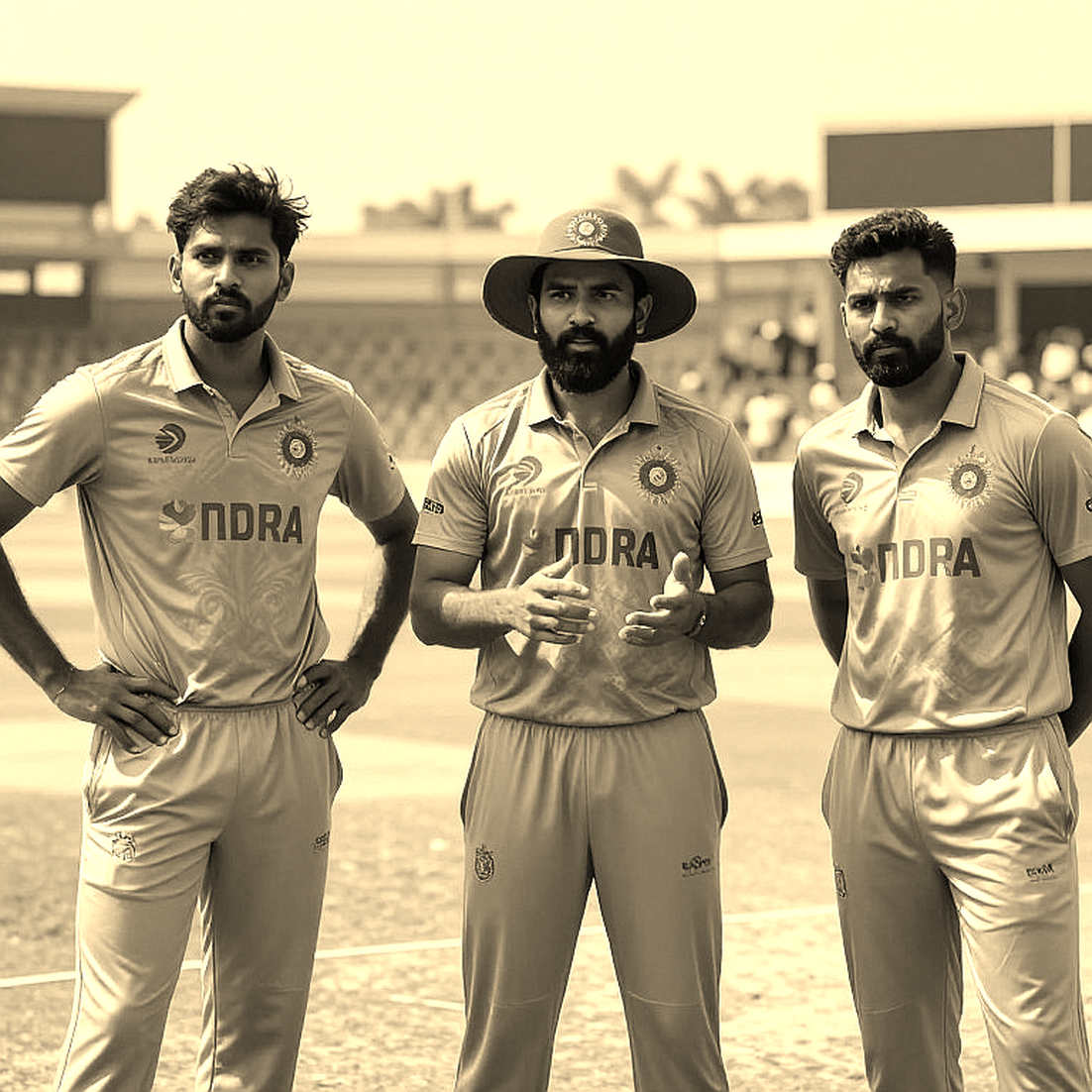
I kept replaying the frame, and the frame kept replaying the question. Nothing on that sheet said dropped. The sheet carried eleven names, and one of them had changed. Everything else was interpretation written over the top of it afterwards.
This is a story about selection process rather than technique, and the first question in any selection process is jurisdictional: whose remit was the call? The selection committee's, the captain's, or the medical staff's? Until that is settled, why was he left out remains an incomplete answer, however many threads are spun.
I have been reading toss-time team sheets for twelve years — first for radio commentary, now for the page. Along the way a habit formed: assume two separate documents sit behind every change. One judges form, the other judges only the body. In Auckland the second document spoke and the first said nothing. The noise was built out of that silence.
Context: what the laws say, and whose dictionary the word dropped belongs to
The ICC playing conditions contain no process called dropping a player. What they contain is this: the captain declares his playing XI at the toss, and after that the XI does not change. No team is obliged to state why any player was left out. So legally, what happened in Auckland is only this: one name replaced another in a declared XI, and the declaration was entirely valid within the rules.
Once that sentence is understood, the rest of the argument has to be split in two. The sporting decision, and the medical decision. In the Indian structure those sit in different hands. Form, balance and matchups belong to the selection committee. Availability and clearance belong to the medical staff. When a player returns from injury, his place is not settled on the form bench — it is settled on the fitness bench.
That is what happened here. Ishan Kishan had recovered from a low-grade strain of the right adductor, the inner-thigh muscle group. Sooryavanshi was given the second and third T20Is in that window as cover. The clearance arrived, and the cover came off. That is the sequence, and it contains no performance metric of any kind.
A transparency note is required here, because this piece operates inside the same limits as its source. The captaincy is attributed to Shreyas Iyer and the series is described as 3–0; both rest on a single source — the Khel Now report — and neither has been cross-checked against official BCCI or ICC records for this article. On the medical detail, the term low-grade adductor strain appears in the source, but no return-to-play protocol, no clearance statement, and no workload cap is recorded anywhere. That absence will matter more than anything else below.
One further piece of context never printed on a team sheet. 30 October means early New Zealand spring — cool temperatures, elevated rain risk, and none of the dew that the March–April window normally brings to Eden Park. On short, straight boundaries the ball travels, which makes bowling first a simpler assignment than defending a total. Iyer chose it.
Angle one: the chronology is the argument
Put the episode in sequence and three dates appear. The confirmation of Kishan's injury. Sooryavanshi's selection for the second and third T20Is. Kishan's return and Sooryavanshi's exit. All three are lines from one document — the medical report. No performance document sits between them. Had the call been form-based, there would be a fourth date on which his innings were assessed. The source carries no such assessment and no batting numbers at all. We have a reason for the exit, and no evidence that an exit was deserved.
Angle two: the pecking order has now become public information
This is the most useful piece of information in the whole affair, and the least discussed. The selectors issued no statement, but they did something more durable — they revealed their preference. A fit Ishan Kishan ranks above Vaibhav Sooryavanshi in the T20I XI. That is not opinion; it is revealed preference, and it carries a date stamp.
Two matches of opportunity followed by immediate withdrawal on fitness is the standard signature of a placeholder role. The system did not reject him; it used him temporarily and returned him. In cricket that is procedure rather than insult — but procedure without communication reads exactly like insult. The source's own conclusion, that he must wait for another opportunity, is consistent with the facts. It is one of the few opinions in that report that does not collide with the structure.
Angle three: the real number-three question is keeping, not batting
Abhishek Sharma and Sanju Samson hold the opening slots and Kishan has been pushed to three. The source tangles itself here — one sentence calls him another option at the top of the order, the next places him at three. Opening and batting at three are not the same job in T20; the six-over fielding restriction and the spin contest that begins in the seventh are different professions. That looseness says a good deal about the rigour of the report.
The substantive question is how a wicketkeeper returning from an adductor strain gets through twenty overs. The adductor is the inner-thigh muscle, and a keeper's work begins there — squatting, lateral push-off, diving. It is a soft-tissue injury with a meaningful recurrence rate. Sending him in at three is a load-management decision, not a batting decision. The source does not say whether any workload restriction was set. That is the largest information gap in the entire episode.
Angle four: the dead-rubber arithmetic runs one way
At 3–0 the fourth match was decided before the first ball. The economics of such a fixture are simple: the risk is real, the reward approaches zero.
The risk is legible. If Kishan breaks down again, the first-choice wicketkeeper is lost ahead of the next assignment — and the injury would have been sustained in a match that did not matter. The reward is legible too: match rhythm, keeping under lights, preparation for the next series. That reward is genuine, and it could have been taken in a live fixture. Selection processes routinely ignore this asymmetry, because a team sheet shows names and never reasons.
Angle five: Mayank for Bhuvneshwar — two plans and one unanswered question
The second change passed almost silently. Bhuvneshwar Kumar out, Mayank Yadav in. An experienced swing bowler replaced by a young express quick. In a live series that swap would have produced three pages of argument. At 3–0 it was disposed of in a line.
Structurally it demonstrates two distinct bowling plans — swing and control with the new ball, or pace and wicket-seeking with it. On a ground with short straight boundaries the second has an obvious logic: where the ball flies, containment is difficult, so the only real control is a wicket. Yet no reason for Bhuvneshwar's omission is recorded — rest, rotation, or form all remain open. The silence lands on the senior bowler whose name came off the sheet and whose story went unwritten. Explaining a system while forgetting the man it lands on is the most common failure in this kind of analysis, and I would rather name him than smooth him away.
Angle six: the dataset that does not exist
A proper analysis of this episode would need Sooryavanshi's ball-by-ball returns from both innings, Kishan's phase-wise T20I strike rate, his history of returning from injury, a pitch report from Auckland, and an assessment of the dew that evening. The source contains none of these.
The consequence is clean: no conclusion about Sooryavanshi's ceiling or Kishan's form can be extracted from this material. Two T20Is are not a sample, they are an anecdote. And the rule cuts both ways — calling a very young player a sensation on two matches is exactly as hasty as writing him off on two matches. The sample is too small to call, and saying so is the honest version of the analysis.
Angle seven: the story that got left out
The most startling fact in this affair is not the selection. It is that New Zealand are 3–0 down at home. Home advantage in T20 is smaller than in Test cricket but far from zero: pitch familiarity, boundary dimensions, crowd, travel fatigue for the visitor all operate. Three straight home defeats is a genuine performance signal, and the report did not give it a sentence.
This is where the system shows its bias. Every ripple in Indian selection generates its own news cycle, while the host side's collapsing campaign gets one clause — and that clause is the hollow assurance that New Zealand will look to bounce back. The 3–0 could equally mean that New Zealand's T20 side is in a rebuild, and India's invincibility could equally mean India met a weakened opponent. Three matches settle neither claim, but the question should have been asked. It was not.
The contrarian angle: the anger is real, the address is wrong
There is a risk of swinging the other way. When the crowd is this loud, assuming it is wrong again is a lazy shortcut. So check the rule first, then check whether the outrage happens to be correct.
At the level of the rule, the anger has the wrong address. No selector sat in a room and removed Sooryavanshi. A fitness clearance arrived and a cover came off. What is being read as a competitive decision is an administrative reversion.
Underneath the rule, though, there is a legitimate grievance and it should not be waved away. The complaint is not that Sooryavanshi sat out. The complaint is that nobody knows how many matches he was in for, in what role, or when he returns. When a young player's pathway is not publicly defined, rumour defines it instead. The team management declared its changes at the toss, which is standard practice and technically sufficient; it gave no reason for Bhuvneshwar's omission, and that silence licenses every interpretation.
One last note on the report that started the argument. Its closing paragraph carries a promotional call to action across five platforms. Building a standalone explainer around a player's non-selection, and dressing it with the word dropped, is a traffic decision rather than a sporting statement. The temperature of the story exceeds its informational payload, and it will not be the last time.
Where this goes
Anyone wanting to know when Sooryavanshi returns should watch three things: the toss sheet for the fifth T20I, Kishan's twenty overs of keeping, and the language in the coming days — whether the word dropped comes back. If it does, the question becomes whose interests are being managed here, the player's or the audience's. A standalone explainer around a young player's absence is proof of his standing; it is not proof of his cricket. On the record available, only the second claim is testable — and it has not yet been tested.