
Golf
Bermuda's 65 and the 128th Place: Joel Dahmen's Real Scorecard
**मुख्य उत्तर**: बटरफ़ील्ड बरमूडा चैंपियनशिप के पहले राउंड में जोएल डाहमेन ने पार 71 पर 65 का स्कोर बनाया, यानी छह अंडर, और वे लीडर चांडलर ब्लैंचेट से तीन शॉट पीछे हैं। असली दबाव स्कोर का नहीं, FedExCup Fall स्टैंडिंग्स में उनका 128वां स्थान है, जो टॉप-125 की कटऑफ़ रेखा से नीचे है। **मुख्य तथ्य**: - 65 का स्कोर पार 71 की पुष्टि करता है; लीडर का नौ अंडर यानी 62, कोर्स रिकॉर्ड के क़रीब का स्कोर। - पोर्ट रॉयल क़रीब 6,800 गज़ का तटीय कोर्स है, जहां सटीकता और बरमूडा ग्रीन पुटिंग निर्णायक रहती है। - GOLF.com की राउंड-2 गाइड में स्ट्रोक्स गेन्ड का कोई आंकड़ा नहीं, इसलिए 65 तकनीकी सबूत नहीं है। - डाहमेन इस सीज़न सिर्फ़ दो टॉप-10 बना पाए हैं और करियर में एक PGA टूर ख़िताब जीता है। - टी-शीट में स्लॉट दोहराए गए हैं, जो टू-टी स्टार्ट और क़रीब 120 खिलाड़ियों के फ़ील्ड का संकेत है। **स्रोत**: GOLF.com, 2026 Butterfield Bermuda Championship राउंड-2 व्यूइंग गाइड, प्रकाशन तिथि 13 नवंबर 2026। **संबंधित प्रश्न-उत्तर**: प्रश्न: डाहमेन का 65 क्यों अपने आप में बड़ी उपलब्धि नहीं है? उत्तर: क्योंकि उसी दिन लीडर ने 62 बनाया, जिससे साफ़ है कि पहले राउंड की परिस्थितियां स्कोरिंग के लिए अनुकूल थीं। प्रश्न: उनके लिए सबसे महत्वपूर्ण संख्या कौन-सी है? उत्तर: FedExCup Fall स्टैंडिंग्स में 128वां स्थान, क्योंकि टॉप-125 की रेखा अगले सीज़न की सदस्यता तय करती है। प्रश्न: दूसरे राउंड में किस चीज़ पर नज़र रखनी चाहिए? उत्तर: बरमूडा की हवा और इस बात पर कि डाहमेन का 65 पुटिंग से बना था या बॉल-स्ट्राइकिंग से, क्योंकि पुटिंग सबसे अस्थिर कौशल है।
The first thing that caught my eye on the Port Royal Golf Course Round 2 tee sheet was not Joel Dahmen's name. The 6:35 a.m. slot appeared twice — once near the top of the list and once among the last groups. That is not a proofreading error; it is evidence of a two-tee start, roughly 40 groups and about 120 players going off both ends at once. And Dahmen? The 6:46 a.m. wave.
That is the detail the broadcast guide never records, and it changes the reading of the week. Morning waves in Bermuda generally get less wind, and less wind means the day on which your 65 arrived matters more than the number itself.
Day one: Dahmen 65, six under. Leader Chandler Blanchet at nine under. Three shots, 54 holes left. In television language this is a comeback race. In ledger language it is something else — and that gap is what this report is about.
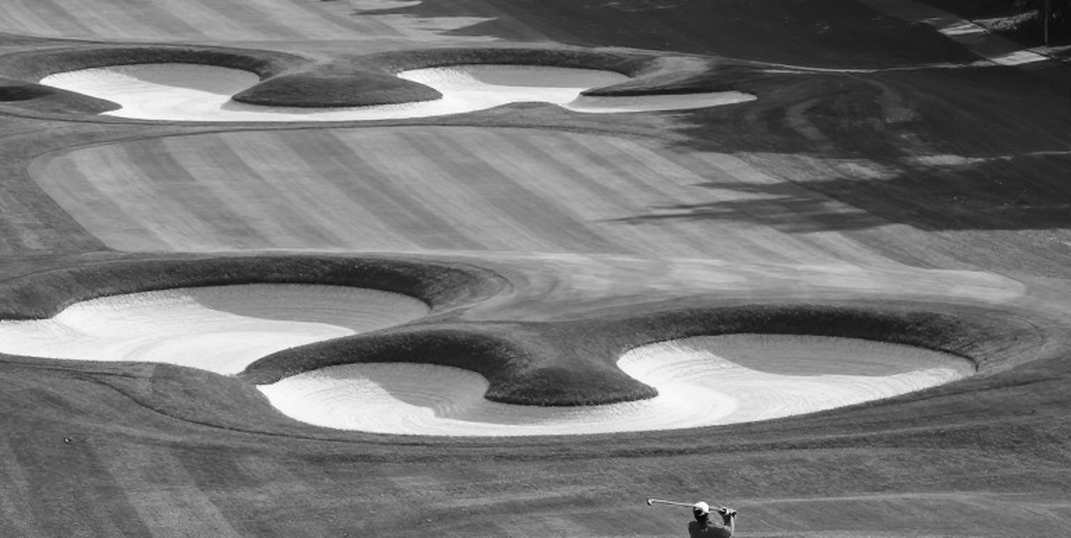
Port Royal: par 71, roughly 6,800 yards, a coastal course exposed to Atlantic wind, on bermudagrass. This is not a layout where driving distance buys anything. Ball-flight control, approach precision and putting on bermudagrass have historically decided it. Long hitters win less here; precise players win more.
The tournament's tier matters just as much. The Butterfield Bermuda Championship is a PGA Tour FedExCup Fall event — below the Signature Events, far below the majors and The Players. The biggest names on the Round 2 tee sheet are Nick Dunlap, Corey Conners, Mackenzie Hughes, Matthieu Pavon, Austin Eckroat, Davis Thompson, Chris Kirk, Lucas Glover, Cam Davis, Tom Hoge and Seamus Power. All respected professionals. None inside the world's top ten.
Now the arithmetic. A 65 means six under, and if six under means 65 then par 71 is confirmed by arithmetic — a conclusion drawn from the scorecard, not from a press release. Apply the same maths to the leader: nine under on a par 71 is a 62.
That sentence is the key to the whole week. A 62 was available on day one. Which means a number close to the course record was already on the board in the first round. The wind was calm, the greens were soft, and one wave got better conditions than the other. On a day when a 62 is possible, six under is not a startling performance — it is a good, decent, ordinary score.
This is where an old habit kicks in. A record is only a rumour until someone reads it twice. In 2026 I applied exactly this logic to the Athletics Federation of India's national record list — 63 entries, of which 11 carried no wind reading, no electronic-timing note and no ratifying body. A four-column grid went up, and half the list came under question.
The same question sits here, only the unit has changed. GOLF.com's viewing guide contains not a single strokes-gained figure — not off the tee, not approach, not putting. So the 65 is a scoreboard artifact, not technical evidence. It is the weakest class of evidence there is, because a 65 can be built three ways: driving, approach, or putting.
Of those three, putting is the most dangerous. Putting is the most volatile skill in golf — one day everything drops, the next day nothing does. If Dahmen's 65 was built on the greens, it will not repeat on Friday. If it was built on approach, the odds are better. But we do not know, because the data was never supplied. Extrapolating a 'legitimate chance' from a single round is precisely the error I flag in other people's copy.
Now the number that gets the least space in this article and matters most: 128th in the FedExCup Fall standings.
That is not a form detail, it is a career status. The top-125 line decides full membership for the following season, and 128th sits below it. Which means this week is not a nice story for Dahmen; it is a fight to keep his card. Even a top-10 could shift his position. A win would do something else entirely.
Because a PGA Tour victory is structural, not incremental. It carries a multi-year exemption, reopens major and Signature Event pathways, and rewrites the next two seasons of the calendar. So the target this week is not a trophy narrative, it is points — and that is a genuine competitive variable that pure form data will never catch.
The form picture runs the other way. Two top-10s all season. One career PGA Tour title, and that at an opposite-field event. This is not emerging form; it is a decline signal, and one 65 does not reverse a season-long trend.
One point of language discipline is needed here. 'Comeback' belongs to a player returning from injury or a long absence. Dahmen never went anywhere. This is a performance slump, not an injury return. Folding the two into one word is the same carelessness that turns a fourth place into a bronze.
Course fit remains open. Port Royal rewards the shorter, more precise player, and on paper Dahmen's profile sits inside that frame. But that is an assumption, not a measurement. His current driving distance, approach proximity and bermudagrass putting splits are nowhere on the record.
One small but real thread is the morning wave. A 6:46 tee time in Bermuda generally meets less wind, and less wind converts directly into score on this course. It is a modest structural edge, to be read cautiously until an actual forecast lands.
Now the part where the ordinary reader and the ledger part ways. 'Three back with 54 holes left' gets read as contention. In a low-scoring event where the winning total usually lands between fifteen and seventeen under, three shots is roughly one good nine holes — technically recoverable. But what it really means is that Dahmen has to win a shootout, not defend one. And shootouts go to whoever has the most repeatable game, which at present is unmeasured.
The second point is less comfortable. Dahmen is a Netflix-era favourite, and popularity attracts editorial attention. The result is that a 65 from a player with two top-10s and a 128th-place standing gets more room than the 62 from the man who actually did the day's biggest work. That is not a talent filter. It is a reputation filter.
For me the real story of this round is not the 65. It is the 62. And bigger still is the fact that nobody flagged it.
Looking ahead, three things will decide the week — the wind picking up, the source of Dahmen's 65 (putting or ball-striking), and the number in Friday evening's standings that is 125, not 65. The question is simple: if his season is being decided by 128th place, why are the headlines about a three-shot gap?

संबंधित खिलाड़ी
लोकप्रिय/पसंदीदा पुस्तकें
The Card at No. 99: Pepperell's Question, Howell's Shortcut, and the Ledger of a Tour That Cannot Say No2026-10-25
Cameron Young's Signature Is in LIV Golf's Bankruptcy Filing — and That Is the Smaller Story2026-10-25
Hatton Is Leaving LIV: 26th in the World, a Masters T3, and a Ledger Where 15 of 21 Entries Carry No Source2026-10-25
Bermuda's 65 and the 128th Place: Joel Dahmen's Real Scorecard2026-10-24
Blanchet's 62 in Bermuda: The Scorecard Talks, Strokes-Gained Stays Blank2026-10-24
A Report Written on a Blank Sheet: When the Golf Story Never Came Out of the Source2026-10-24
अनुशंसित
The Price of an Empty Cell: The Unbooked Loss Inside Golf's Data Chain2026-10-24
The Card at No. 99: Pepperell's Question, Howell's Shortcut, and the Ledger of a Tour That Cannot Say No2026-10-25
Blanchet's 62 in Bermuda: The Scorecard Talks, Strokes-Gained Stays Blank2026-10-24
Korn Ferry Tour 2026: Where Ninth in the Points List Leaves a Bigger Question Than Twentieth2026-10-24
Cameron Young's Signature Is in LIV Golf's Bankruptcy Filing — and That Is the Smaller Story2026-10-25
A Report Written on a Blank Sheet: When the Golf Story Never Came Out of the Source2026-10-24
Hatton Is Leaving LIV: 26th in the World, a Masters T3, and a Ledger Where 15 of 21 Entries Carry No Source2026-10-25
Bermuda's 65 and the 128th Place: Joel Dahmen's Real Scorecard2026-10-24
अनुशंसित
Cameron Young's Signature Is in LIV Golf's Bankruptcy Filing — and That Is the Smaller Story2026-10-25
Bermuda's 65 and the 128th Place: Joel Dahmen's Real Scorecard2026-10-24
Blanchet's 62 in Bermuda: The Scorecard Talks, Strokes-Gained Stays Blank2026-10-24
Hatton Is Leaving LIV: 26th in the World, a Masters T3, and a Ledger Where 15 of 21 Entries Carry No Source2026-10-25
Korn Ferry Tour 2026: Where Ninth in the Points List Leaves a Bigger Question Than Twentieth2026-10-24
A Report Written on a Blank Sheet: When the Golf Story Never Came Out of the Source2026-10-24
The Price of an Empty Cell: The Unbooked Loss Inside Golf's Data Chain2026-10-24
The Card at No. 99: Pepperell's Question, Howell's Shortcut, and the Ledger of a Tour That Cannot Say No2026-10-25
अनुशंसित
The Price of an Empty Cell: The Unbooked Loss Inside Golf's Data Chain2026-10-24
Blanchet's 62 in Bermuda: The Scorecard Talks, Strokes-Gained Stays Blank2026-10-24
A Report Written on a Blank Sheet: When the Golf Story Never Came Out of the Source2026-10-24
Cameron Young's Signature Is in LIV Golf's Bankruptcy Filing — and That Is the Smaller Story2026-10-25
Bermuda's 65 and the 128th Place: Joel Dahmen's Real Scorecard2026-10-24
The Card at No. 99: Pepperell's Question, Howell's Shortcut, and the Ledger of a Tour That Cannot Say No2026-10-25
Korn Ferry Tour 2026: Where Ninth in the Points List Leaves a Bigger Question Than Twentieth2026-10-24
Hatton Is Leaving LIV: 26th in the World, a Masters T3, and a Ledger Where 15 of 21 Entries Carry No Source2026-10-25
अनुशंसित
Hatton Is Leaving LIV: 26th in the World, a Masters T3, and a Ledger Where 15 of 21 Entries Carry No Source2026-10-25
Korn Ferry Tour 2026: Where Ninth in the Points List Leaves a Bigger Question Than Twentieth2026-10-24
A Report Written on a Blank Sheet: When the Golf Story Never Came Out of the Source2026-10-24
Cameron Young's Signature Is in LIV Golf's Bankruptcy Filing — and That Is the Smaller Story2026-10-25
Bermuda's 65 and the 128th Place: Joel Dahmen's Real Scorecard2026-10-24
Blanchet's 62 in Bermuda: The Scorecard Talks, Strokes-Gained Stays Blank2026-10-24
The Price of an Empty Cell: The Unbooked Loss Inside Golf's Data Chain2026-10-24
The Card at No. 99: Pepperell's Question, Howell's Shortcut, and the Ledger of a Tour That Cannot Say No2026-10-25